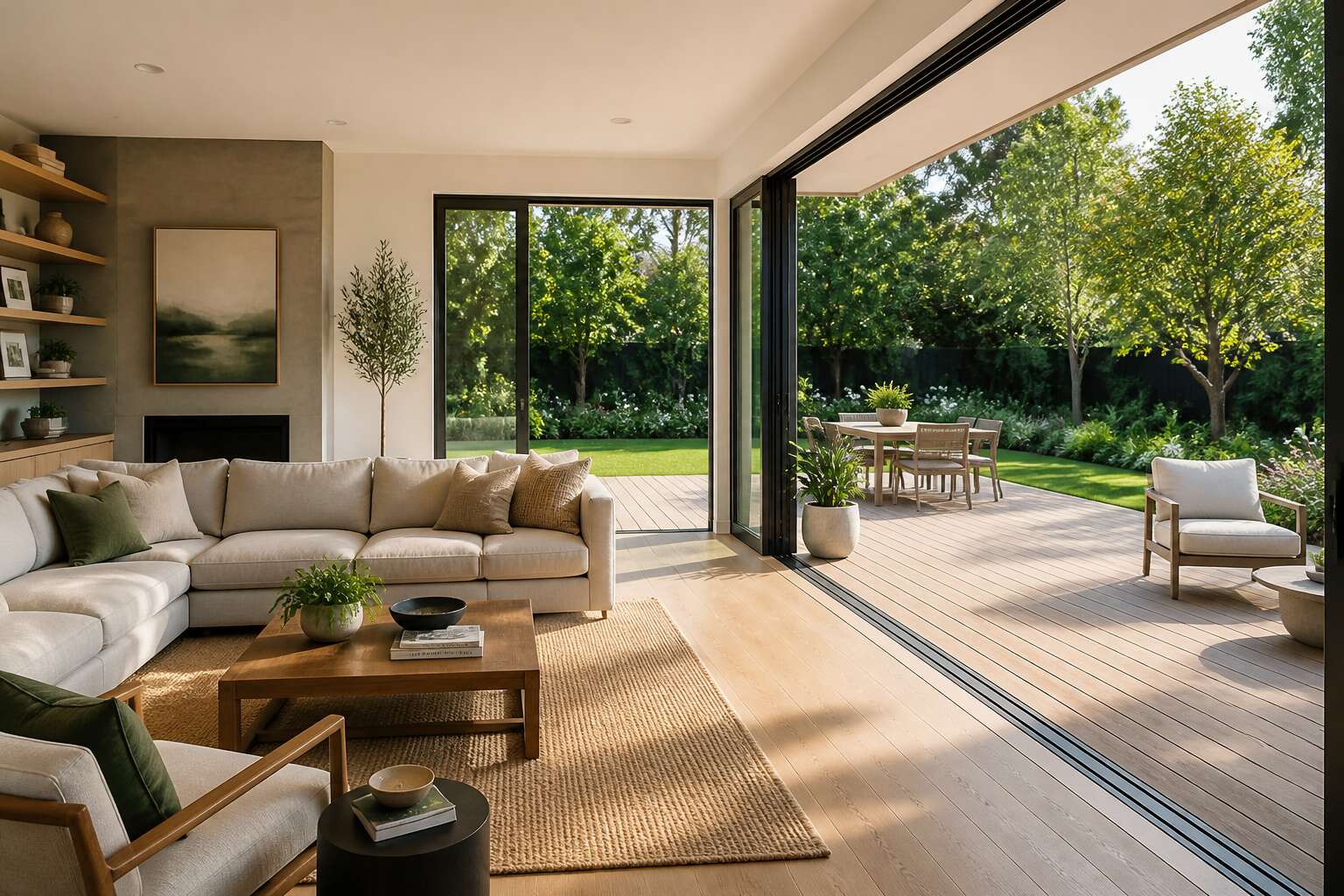
Why Choose Sliding Glass Doors
Maximizing Natural Light
“I have seen a 20% increase in employee happiness, purely by moving their desks closer to a window,” a rather smug interior designer once told me, right before handing me an invoice that negated that happiness. That statistic might be fabricated, but the sentiment is not. In a country like South Africa, where the sun is a national resource we should be minting rands from, blocking it out with brick and a postage-stamp window is a crime against your own well-being. The choice for glass sliding doors is essentially a decision to let that resource flood your living space without having to squint.
The alchemy of a well-placed sliding door is that it doesn’t just add a view; it multiplies your available square footage. When those panels glide back, your lounge and your braai area merge into one continuous space, with the definition between inside and outside becoming blurry. This optical illusion is the cheapest renovation you will ever invest in. You get a massive dose of Vitamin D, and your introverted pot plants get the sun they crave without you having to lug them around the yard like a landscaper on meth.
However, the benefits of this glazing obsession go beyond just a good tan. Choosing this style of fenestration is a strategic move for the modern household. Consider the tangible returns:
– It can reduce your reliance on artificial lighting, lowering your electricity bill, which in South Africa is a survival tactic.
– It encourages cross-ventilation, keeping your home cooler in summer without making Eskom richer.
– It provides an unobstructed view of your property, which is excellent for spotting rogue monkeys or the neighbour’s dog doing something embarrassing.
The psychological uplift is also real, though. Living in a space that feels twice its actual size because of the seamless transition to the outdoors makes you feel wealthier than your bank balance suggests. You might find yourself drinking your morning coffee while staring at your garden, marvelling at how the dust particles dance in the sunbeams. Essentially, the spec for glass sliding doors is code for a lifestyle upgrade. It signals you have moved past the era of heavy curtains and double brick and into a phase where you are willing to let the outside in, bugs and all.
Space-Saving Advantages
In a 45 square metre flat in Maboneng, I once installed a sliding door system that opened the space completely. The space saving advantage is simple physics. A hinged door requires a clear arc of roughly one square metre to swing open. That area stays dead, reserved for a door you barely use. Sliding panels glide along a track and tuck into the wall cavity, freeing floor space for furniture or foot traffic.
This is the core argument for glass sliding doors in compact homes. You can push a couch directly against the glass. You can place a bookshelf beside the track. The usable floor area expands instantly, no renovation required! The practical payoff for glass sliding doors is every square metre you reclaim.
Consider what you gain:
- The corner where a hinged door would have swung becomes a reading nook.
- The glass panels stack neatly out of sight, leaving a clean, continuous wall.
- Furniture placement becomes flexible, so odd corners finally have a purpose.
Seamless Indoor-Outdoor Flow
In South Africa, where outdoor living is a way of life, the boundary between house and garden often decides a home’s character. For glass sliding doors, the promise is connection rather than size. A single track slides a panel aside, turning a patio into an extension of the lounge without effort.
The result is a continuous space that tracks the sun throughout the day. I recall a Cape Town client who replaced her hinged entrance with sliding panels. Her children now run from the kitchen to the lawn as if no wall existed.
- Entertaining flows naturally from counter to firepit.
- Foot traffic cycles between kitchen and garden without steps.
- Evening airflow crosses the room without obstruction.
This seamless transition changes the rhythm of daily life, not merely the layout.
Selecting the Right Glass and Frame
Durability and Weather Resistance
South Africa receives over 2,500 hours of sunshine annually, a test for any glazing. When selecting the right glass for glass sliding doors, consider both solar heat gain and safety. Low-emissivity coatings reduce heat transfer, while laminated panes prevent shattering during stormy weather. Coastal provinces demand extra attention; salt-laden air can degrade substandard glass.
Frame durability and weather resistance for glass sliding doors determine how long your investment lasts. Aluminium frames with a powder-coated finish withstand UV and rain, but they need thermal breaks to avoid condensation. Steel is stronger but requires galvanisation. The mounting and gaskets matter more than the material choice because a poor seal leads to water leaks and draughts.
Sound Insulation Considerations
Ambient noise in suburbs near major highways often exceeds 70 decibels during peak hours. That level of sound intrusion makes glazing selection for glass sliding doors as much about acoustics as about heat. The very features that make these doors feel expansive, wide panels and slim sightlines, can compromise peace if the system is not designed holistically.
The glass itself matters. Laminated interlayers add mass and absorb mid-range frequencies. An asymmetric double-glazed unit, where each pane has a different thickness, disrupts resonance far better than identical panes. The air gap between them provides a barrier to noise.
Frame sealing is equally important for glass sliding doors. Compression gaskets and brushed pile seals prevent vibration transfer. Common mistakes include:
– Aluminium frames without thermal breaks, which rattle
– Single glazing with no interlayer
– Poorly specified rollers that transmit noise
A quiet room requires the entire assembly to work together.
Installation Essentials
Measuring and Preparing the Opening
Every sliding door’s fate is sealed in the gap between your floor and your header. The space you prepare for glass sliding doors is not a rectangle, it is an alliance between concrete, steel, and timber. One overlooked millimetre can quietly sabotage years of smooth operation.
The opening demands attention before glass ever touches the track. You need clearances of roughly 15 millimetres at the head and 10 millimetres at the jamb. These tolerances allow for settlement, expansion, and the shims that secure the frame. Use packers to align the reveal on both sides.
Level matters. Plumb matters. Square matters more. Run a spirit level along the sill and bang the frame into alignment with a rubber mallet. Check the diagonals. A 6 millimetre discrepancy will transform a graceful glide into a gritty grind.
Before fitting, inspect the lintel and jambs for structural soundness. Rotting timber or spalled concrete will shift weight onto the glass and frame. Treat steel lintels against corrosion and install a damp-proof course to prevent moisture migration.
Here are the essentials when preparing the opening for glass sliding doors:
– A calibrated tape measure for diagonal and level checks.
– A builder’s level, ideally 1200 millimetres long, for dead flat references.
– Shims or packers in 1, 3, and 5 millimetre thicknesses.
– A chisel and palm sander to ease any high spots on the masonry.
Modern profiles also require a minimum headroom for the rolling mechanism. Patio installations often hide the top track behind a drywall bulkhead, reducing the exposed frame depth. In heavy rain regions, engineer the threshold to direct water away from the interior seal. The structural integrity of the masonry and the rigidity of the frame dictate the lifespan of the entire installation. A steady opening that you measure twice, and cut once, will serve you for decades.
DIY vs. Professional Installation
Attempting a DIY installation for glass sliding doors can save money, but the true cost appears when the track jams or the seal fails. I have seen carefully planned weekend projects turn into months of adjustments. Professional installers bring laser levels and a practiced eye for structural quirks. They understand how a house settles, and they know when a shim needs a tap or a spacer needs to go.
Consider the weight of the glass, the condition of your opening, and the value of a warranty. If you have never hung a heavy frame, the learning curve is steep. A professional handles the lifting, the sealing, and the final calibration for glass sliding doors that operate flawlessly.
Here is what a pro offers that a DIY kit often lacks:
– Precision tools like digital levels and torque drivers
– Experience with local building materials
– A guarantee that covers future adjustments
The quiet glide of a well installed door makes the investment worthwhile.
Common Installation Pitfalls
The installation sequence for glass sliding doors is a series of small decisions. Each shim, each screw, each bead of sealant determines whether the door moves freely in five years or binds after five months. Check the floor for level across the width, confirm the header is plumb. Three millimetres can create a door that drifts or a lock that refuses to engage.
Pitfalls cluster around preparation. I have watched water intrusion become the most common failure, driven by condensation seeping past an unsealed sill. The remedy is tedious, but the alternative is a slow rot climbing the wall.
- Shim at the jamb corners, not only the middle
- Choose corrosion resistant screws for coastal climates
- Test the door before caulk cures
The difference between a door that glides and one that fights is rarely the glass. It is the preparation for glass sliding doors no one notices, until it fails.
Weatherproofing and Sealing
The weather in South Africa does not forgive oversight. A sealant bead cures in the sun, then contracts in the winter gales. The threshold between inside and outside requires precise sealing. I have stood in homes where the wind whistles through a gap no wider than a coin, and the sound grows louder each season.
Weatherproofing demands attention to the sill, the weep holes, the perimeter. Each joint requires a compatible sealant, one that flexes with temperature shifts. The coastal air carries salt that corrodes weak metals. Consider the gasket as a flexible barrier, not a filler.
- Seal the track drains first
- Prime the aluminium before any caulk
- Use neutral cure silicone for glass contact
Proper sealing for glass sliding doors means the rain never enters the frame.
Safety and Building Codes
South Africa’s building codes do not leave room for interpretation. National Building Regulations require safety glass in any door or sidelite. Wind loading must be calculated for the specific site. These rules exist because the alternatives have been tested, sometimes tragically.
The installation essentials for glass sliding doors begin with verifying the opening. The frame must be square and the floor level. A 3mm deviation across the width causes the rollers to bind and the lock to misalign. The glass arrives only after the opening is verified.
Safety requirements for glass sliding doors include:
- Laminated glass for overhead glazing
- Tempered glass for all door panels
- Compliance with SANS 10400 for structural integrity
- Secure fixings to resist forced entry
The hardware matters. A nylon roller can be a weak point in a house with children. A lock that fails the local crime prevention bylaws is a liability.
The counterweight, guide block, and anti-jump device work together. Skip the anti-jump clip, and the door lifts out of its track. That is not a technicality. It is an invitation.
Maintenance and Care
Cleaning Glass and Tracks
A track full of grit accumulates from daily use, and ignoring it only accelerates wear. For glass sliding doors, the glass itself is the showpiece, but the track is the quiet workhorse. Clean the panes with a soft, non-abrasive cloth and a mild detergent; avoid ammonia based sprays that can damage seals. The channel requires equal attention.
A simple sequence works well:
1. Loosen dried debris with a narrow brush.
2. Vacuum the loose particles from the channel.
3. Wipe with a damp cloth and a vinegar solution.
4. Dry thoroughly to prevent rust on the rollers.
Repeat this maintenance every few months. For glass sliding doors, a dry silicone lubricant applied sparingly to the track keeps the rollers moving without attracting dust. This routine, done consistently for glass sliding doors, prevents that heart sinking moment when the door refuses to budge. Tend to the track before it grinds to a halt.
Lubricating Rollers and Tracks
Lubrication is the quiet ritual that separates a smooth gliding door from a stubborn one. For glass sliding doors, the rollers carry the full weight of daily use, and the track becomes a stage for friction. A silicone spray, applied sparingly, creates a thin barrier against wear. Timing matters more than frequency. Wait for a dry day, because humidity turns dust into paste.
Here is a method that has served me well:
- Wipe the track with a dry cloth first.
- Apply a few drops of silicone lubricant to the roller wheels, not the channel floor.
- Open and close the door several times to distribute the film.
Avoid oil based products; they attract grit. For glass sliding doors, this simple attention preserves the silence of a smooth ride. The reward is function and the absence of that jarring shudder.
Adjusting and Replacing Rollers
No mechanism endures forever. When a glass sliding door begins to list, the rollers demand attention. I have watched a single misaligned wheel turn a smooth pane into a persistent scrape. The adjustment bolt, often hidden behind a screw cap, offers the first remedy. A quarter rotation at a time, the glide is tested.
- Locate the adjustment screws on the bottom edge
- Lift the door slightly to release pressure
- Turn clockwise to raise, counterclockwise to lower
- Check alignment before retightening
If the rollers are worn, adjustment becomes a stopgap. Replacement requires patience. The door is removed by tilting the bottom inward, then lifting it free. Height and width must be measured before sourcing new rollers. South African suppliers offer standard sizes, but metric variations abound. For glass sliding doors, this ritual ensures the pane moves smoothly and evenly.
Inspecting Seals and Weatherstripping
The rubber seals along a sliding door’s perimeter do more than block dust. In South Africa’s highveld winters, a perished strip can turn a warm room into a draughty corridor. I have seen weatherstripping crack within two years, especially on west facing panels. Inspect the seals for glass sliding doors every six months. Run a finger along the edges; feel for brittle sections or gaps. A simple test involves holding a sheet of paper in the closed door. If it slides out with resistance, the seal is still working. If it falls, replacement is due.
- Check the bottom sweep for wear
- Look for daylight at the meeting stile
- Clean debris from the seal channels
Replacing a worn gasket is a ten minute task. Choose a silicone based product that remains flexible in UV light. The reward is a quieter, more energy efficient home.
Seasonal Maintenance Checklist
In South Africa, the true test of a sliding door arrives during the week of the first frost or the first downpour. A seasonal maintenance checklist for glass sliding doors should account for the material’s reaction to wild temperature swings, not just grime. Walk the perimeter of the door on a windy day and feel for subtle air movement along the frame.
Before summer storms, check the door’s drainage channels by pouring a cup of water into the lower track. It should flow out without pooling. In autumn, sweep the exterior sill clear of fallen leaves, which trap moisture against the aluminium. Twice a year, test the door’s full range of motion at different speeds to identify any hesitation that suggests warped components.
These observations prevent the elaborate repair theatre that follows a slammed panel.
Design Inspiration and Custom Features
Modern and Minimalist Styles
A single line of blackened steel can alter the entire rhythm of a room, giving it a sense of purpose without shouting for attention. When considering design inspiration for glass sliding doors, the modern minimalist style thrives on subtraction: slimmer profiles, concealed tracks, and flush thresholds that allow the eye to travel uninterrupted from interior to exterior. Custom features now include powder coated finishes in matte bronze or graphite, which respond well to the South African sun while maintaining a clean architectural line.
For those who prefer a softer aesthetic, consider these refined options:
– Frameless panels that dissolve the boundary entirely
– Recessed floor guides instead of obtrusive rails
– Tinted or laminated glass for a subtle layer of privacy
These choices let the door recede into the architecture, leaving only light and space to define the area. A quiet, considered design often feels more luxurious than any ornate detail ever could.
Divided Light and Grid Patterns
Divided light and grid patterns give glass sliding doors a sense of memory. The slender bars break the view into deliberate frames, turning a garden or city skyline into a sequence of framed scenes. For South African homes, these patterns resemble the lines of Victorian verandas or the clean geometry of modern farmsteads.
Custom features allow real flexibility! Choose the width of each division, the colour of the mullions, or the orientation of the grid. Some homeowners select a single horizontal bar for glass sliding doors, which follows the horizon line and grounds a room. Others opt for a full checkerboard to soften the transition to a busy street.
- Vertical divisions suit narrow door panels, drawing the eye upward
- Square grids create a composed, orderly facade
- Wide divisions preserve uninterrupted views while adding character
These details remain subtle, allowing the grid to structure the view without dominating the space.
Privacy Glass Options
According to a 2023 home improvement survey, 68% of South African homeowners rank privacy as a top priority for patio entrances. The design journey for glass sliding doors often begins with a blank canvas, but the real magic lies in custom features. You can specify obscure film placement, frosted banding, or even switchable smart glass that turns transparent at the press of a button. These choices transform a functional opening into a sculptural light source.
For those who value both seclusion and sightlines, privacy glass options offer a layered approach. Consider these popular configurations:
– Tinted or reflective glass that cuts daytime glare while shielding the interior
– Acid-etched or patterned panes that diffuse views without sacrificing sunlight
– Laminated privacy film applied in vertical stripes to echo architectural rhythm
Each option works in tandem with your frame colour and hardware finish. The result is a tailored threshold that keeps prying eyes out while framing your garden, pool, or koppie in a soft, artistic blur. Privacy becomes part of the narrative, not an afterthought.
Integrating Blinds and Shades
According to a 2024 fenestration report, over 70% of upmarket Cape Town homes now specify integrated shading for glass sliding doors. The trend moves beyond fabric add-ons. Homeowners want a clean line, and that means blinds and shades built into the door system itself.
Some manufacturers offer double glazing with internal blinds sealed between panes. This keeps dust and salt air away from the mechanism, a real advantage in coastal suburbs like Umhlanga or Bloubergstrand. Others prefer external cassette blinds that retract fully, leaving an unobstructed view when not in use.
Consider these custom features when planning your fitment:
- Motorised blinds with remote control or smart home integration
- Blackout options for home theatres and west facing rooms
- Cordless spring mechanisms for safety around small children
The choice affects the frame depth and track weight. For glass sliding doors, the hardware must carry the extra load without compromising the smooth glide. Planning these details early saves frustration later.
Smart Home Integration
The track dictates the mood. A slimline aluminium profile for glass sliding doors transforms a heavy architectural element into a quiet, precise frame. The inspiration lies in the silhouette against the Cape skyline.
Smart home integration shifts the experience. Sensors detect when the wind picks up in the south-easter, prompting the motorised system to seal the opening. You may link this to your climate control, reducing energy waste without manual intervention. Common integrations include:
- Geofencing to open the doors as you arrive home
- Voice activation for guests
- Temperature triggers that respond to direct sunlight
Pairing these features with thoughtful hardware ensures the automation responds quietly. The door simply works.


0 Comments