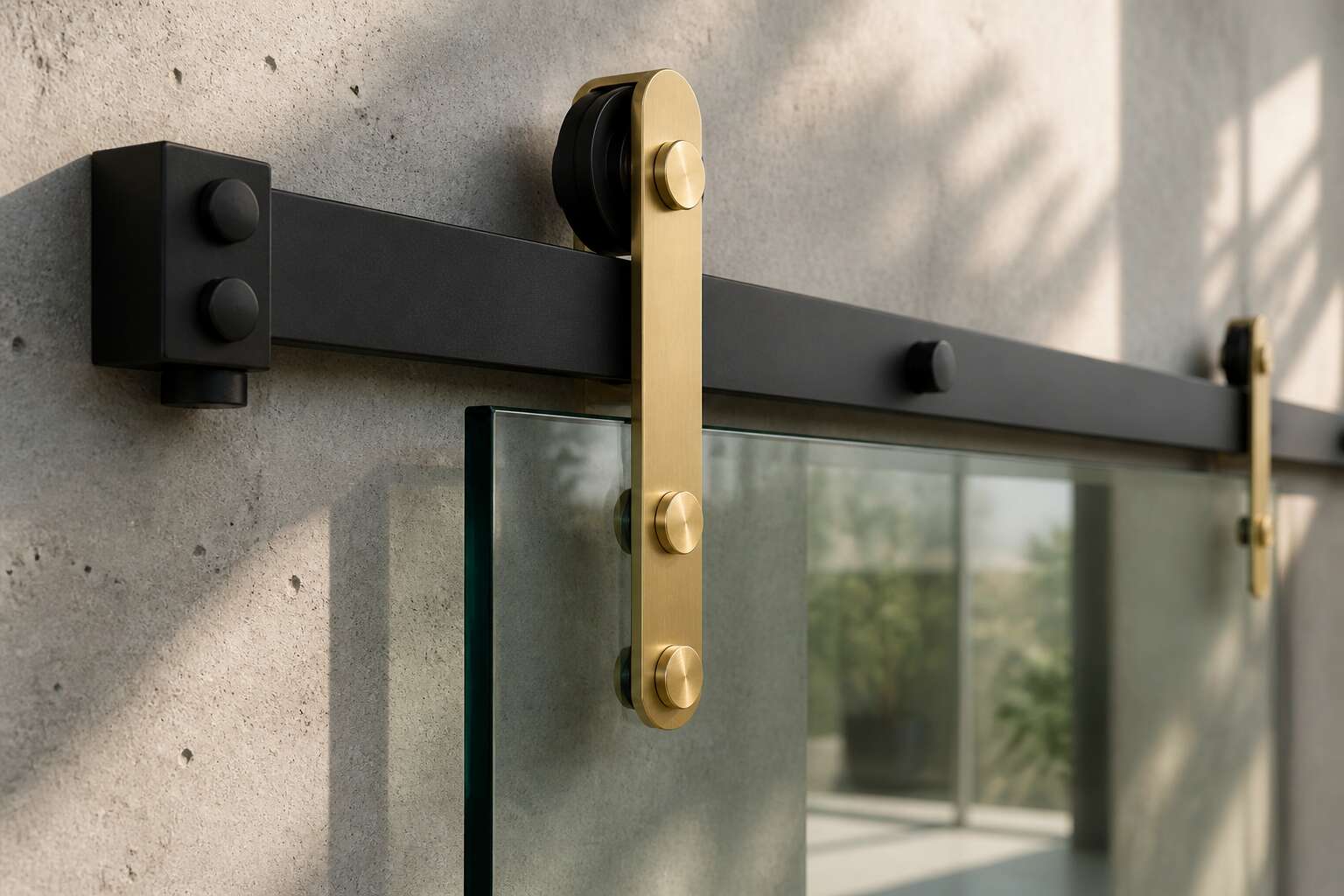
Core Components of Modern Sliding Door Systems
Understanding Rollers, Tracks, and Guides
Nearly 70% of sliding door malfunctions trace back to worn rollers or misaligned tracks, yet most homeowners never inspect these components. The performance of any sliding doors hardware system rests on the quiet mechanics beneath the visible frame, the parts that carry the weight of every open and close.
Rollers carry the panel along tracks that must stay perfectly level. Guides, often overlooked, keep the path true. When these elements work together, the door moves with effortless ease. When they fail, you feel it in every hesitant push!
- Nylon rollers provide quiet, corrosion resistant movement
- Stainless steel tracks handle coastal South African humidity
- Floor guides prevent lateral sway in high winds
I have seen sliding doors hardware fail not from dramatic breakage, but from slow neglect. A grain of sand in a track, a loose bearing, a guide clip out of place. Understanding these core components changes how you care for the portal between your home and the outdoors.
Buffer Stops and Floor Guides: Keeping Doors Aligned
When a sliding door finally refuses to glide, the culprit often sits not in the tracks, but in the tiny components designed to stop momentum. Buffer stops and floor guides are the quiet arbiters of alignment. They determine whether the door rests flush against the frame or drifts into a frustrating, scraping misalignment. In South African homes, where coastal winds and uneven flooring are common, these parts face constant, unseen pressure.
A floor guide secures the bottom pivot point. It holds the door steady against lateral movement. Without a functional guide, the door swings on its vertical axis, placing strain on the rollers above. This strain is the genesis of that grinding sound you hear during a sudden gust.
The buffer stop, often a small rubber or plastic block, absorbs the impact of the door’s final swing. The materials determine the lifespan:
– Reinforced nylon stops resist UV degradation in Durban sun
– Adjustable floor guides accommodate the settling of foundations
– Magnetic catch buffers hold the door securely in severe weather
Choosing the right sliding doors hardware means considering the wind profile of your specific suburb. A guide that works in Johannesburg’s still air might fail in Cape Town’s southeaster. These components are not decorative. They are functional insurance for the entire system. When overlooked, they compromise the investment made in the frame and glass.
Anti-Derailment Devices and Safety Features
Wind loads along the South African coast can lift a sliding door by several millimetres in a single gust. That small rise is enough for the wheels to slip free of the track. Anti-derailment devices exist to close that window of failure. These components, usually interlocking clips or overhead brackets, anchor the door to the rail while leaving lateral movement unrestricted.
The effectiveness of this protective layer depends on the tolerance between the top guide and the track groove. When a gust presses against the glass, the anti-lift block engages with the underside of the rail, preventing upward motion entirely. The door cannot rise, regardless of wind pressure.
Modern sliding doors hardware incorporates several layers of fail-safe engineering:
- Anti-lift blocks seated in the upper track channel
- End stops with shock-absorbing polymer cores
- Wind-load restrictors that respond to oscillation frequency
These elements operate without sound or visible movement. They resist forces that only announce themselves during a storm, holding the system together when it matters most.
Load-Bearing Capacity and Material Considerations
Every sliding door bears more than its own weight. The glass, frame, and wind pressure all act on components that must respond without visible strain. Coastal South African homes demand systems that handle salt-laden air. The load-bearing capacity of sliding doors hardware determines whether a door glides for decades or fails within a few seasons!
Powder-coated aluminium resists corrosion, while stainless steel rollers distribute weight evenly. In my experience, a door rated for 150 kilograms feels like one rated for 80, but the difference appears over time. The track must match the wheel profile, and the wheel must match the load specification.
Consider these factors:
- The combined weight of glass, frame, and any added inserts
- The wheel count and axle diameter
- The track material, whether aluminium, steel, or PVC
Each decision shapes system behaviour. Ignoring load ratings leads to premature wear. The right sliding doors hardware carries its burden quietly.
Choosing the Right Track System for Your Project
Top-Mounted vs. Bottom-Mounted Tracks
The quiet luxury of a sliding door begins with a decision most people never see, yet feel every single day. It is the fundamental choice of where to hang the weight and how to guide the journey. This selection influences not only the door’s motion but also the architectural integrity of the entire opening.
Choosing the right track system is an exercise in structural honesty.
– Top-mounted tracks carry the full load of the door leaves, deferring to the ceiling or header for support. This demands a robust structural header, but rewards you with a clear, uninterrupted floor line.
– Bottom-mounted tracks anchor the system to the floor, which often adds relative ease to the header requirements. They provide a grounded stability, yet you must accommodate the floor groove, which can interrupt the visual flow of your space.
The beauty of the top-mounted approach lies in its seamless integration, allowing the floor to remain a continuous plane. Conversely, bottom-mounted systems often find their calling in specific subdivisions, such as library ladders or rustic barn doors, where the tactile feedback of the floor guide is part of the charm. Your choice in sliding doors hardware dictates the character of the building, turning a functional necessity into a statement of purpose. Ultimately, the tangible difference is between invisibility and interaction, a decision that shapes the daily ritual of moving through your home.
Track Materials: Aluminum, Steel, and Stainless Steel
Track material determines how long your sliding doors hardware survives the South African climate. Coastal salt air attacks untreated metal, while inland humidity tests every component. The correct specification begins with the environment.
Aluminum tracks resist corrosion naturally and suit most interior installations. Steel tracks offer rigidity and are often galvanised or powdered for protection. Stainless steel tracks contain chromium, which forms a self-healing oxide layer, making them the preferred choice near the ocean.
- Aluminum: corrosion resistant, lightweight, economical
- Steel: rigid, strong, requires coating
- Stainless steel: highest corrosion resistance, premium cost
On a coastal property, I have seen coated steel tracks fail within two seasons. The surrounding environment dictates the correct sliding doors hardware. Matching material to climate prevents rust, binding, and early replacement.
Flush vs. Surface-Mounted Track Profiles
Choosing between a flush track and a surface-mounted profile is as much about social manners as it is about engineering. A flush track, recessed into the floor or ceiling, creates an uninterrupted line that guests will admire without ever noticing why. Surface-mounted tracks speak plainly, their presence acknowledged and accepted as honest hardware.
Flush profiles suit minimalist interiors where the sliding doors hardware should whisper rather than announce itself. Surface-mounted options, by contrast, are practical for renovations where structural changes are impossible or where the budget prefers simplicity.
Consider the threshold. A flush floor track allows wheelchairs, walking frames, and bare feet to pass without judgement. Surface-mounted tracks demand a small step, a subtle tripping hazard for the distracted visitor who is too busy complimenting your taste.
- Flush: seamless appearance, requires planning during construction
- Surface-mounted: quick installation, adaptable to existing frames
The choice between them shapes how a room feels and how freely people move through it. Get it right, and nobody notices a thing. Get it wrong, and every guest learns the exact location of that little metal lip.
Curved and Bypass Track Configurations
Projects often reveal their true character at the threshold of choice. For spaces with curved walls or bay windows, curved track systems allow sliding doors hardware to follow the architecture rather than fight it. Radius tracks require precise measurement and quality trolleys, because any deviation shows in the door’s movement.
Bypass configurations offer a different kind of subtlety. Two or more panels slide on parallel tracks, passing each other without the need for wall pocket clearance. This system suits wardrobes, room dividers, and compact living areas where a single sliding door would waste valuable floor space.
- The stacking zone determines how far the doors can travel
- Curved radii need larger spacing between rollers
- Bypass systems demand parallel tracks with consistent clearance
Each configuration asks the same question of sliding doors hardware: how much space can your interior afford for the mechanics of movement?
Matching Track Length and Door Weight Capacity
One in three sliding door failures traces back to a mismatched track and hardware pairing, a silent imbalance that surfaces only after installation. Choosing the correct slide system involves two measurements that do not forgive approximation: the running length of the track and the combined mass of every door panel it must carry. The track must extend to at least double the width of the doorway for a standard single panel, and the rollers must be rated for the combined weight of all panels, not just one.
– Measure the doorway width and add the full width of a single door panel to determine minimum track length.
– Sum the weight of every panel that will move along the same set of tracks.
– Confirm the roller rating exceeds that total by at least 20%.
A bypass system with two lightweight timber panels might require a track length far exceeding the opening, yet the load remains modest. A single solid steel door on a curved radius demands less length but a considerably higher weight capacity per trolley. The sliding doors hardware must match the curve radius, the stacking zone, and the static load, otherwise the door will settle into a perceptible sag within months, and the smooth motion you paid for becomes a grinding negotiation. Get both numbers right before you order, and the mechanism disappears into the wall, silent and dependable.
Rollers, Hangers, and Trolleys Demystified
Ball-Bearing Rollers vs. Teflon Wheels
Ball bearing rollers and Teflon wheels serve different purposes in sliding doors hardware. Ball bearing rollers distribute weight through hardened steel races, making them the sensible choice for heavy timber doors. Teflon wheels run quietly but deform under sustained load, so they suit lightweight aluminium frames.
Coastal conditions complicate the choice. Salt laden air damages unsealed components, while sealed ball bearings hold up better in Cape Town’s marine climate. Teflon remains popular for interior wardrobes where noise matters more than lifespan.
Consider the trade offs:
– Ball bearing: higher load capacity, smoother rolling, longer service life
– Teflon: quieter, cheaper, requires replacement sooner
Hangers and trolleys carry these wheels within adjustable brackets. The bracket adjustment range dictates how precisely you can level the door, so verify this before purchasing sliding doors hardware online.
Single vs. Double Hanger Carriers
Most people never think about the hanger carrier until the door starts scraping. The difference between a single and double carrier comes down to load distribution. A single hanger carrier holds the door at one point, which works for lightweight interior doors. A double hanger carrier distributes the load across two sets of wheels, reducing flex in the track and keeping the door level.
For South African homes with large wooden doors, a double carrier is often the safer choice. It gives you more adjustment range, so you can fine tune the height without shimming. A single carrier saves money, but it concentrates wear on one roller. That means you will replace sliding doors hardware sooner than you expect.
Quiet-Glide Technology and Noise Reduction
Quiet glide is the promised luxury of a well engineered door, yet few homeowners understand what actually delivers it. The roller, the hanger, and the trolley form a working triumvirate that governs how smoothly a door travels. When each element cooperates, the door moves with barely a whisper. When they do not, you get the grating screech that announces your arrival to the entire household.
The real secret to noise reduction sits in the wheel material and the bearing precision. Nylon wheels with sealed ball bearings absorb vibration far better than bare metal rollers. The hanger holds the door at the correct height, while the trolley carries the load along the track. Alignment matters more than lubrication. A single millimeter of misalignment creates friction, and friction creates noise.
Quality sliding doors hardware accounts for this by building adjustability into the carrier. South African homes experience temperature swings that cause track expansion, so this fine tuning capability is not a luxury. It is a necessity for keeping your doors silent and your evenings undisturbed.
Replacing and Retrofitting Existing Rollers
The roller fails first, yet homeowners consider it last. Replacing an existing roller assembly requires a clear hand and a precise eye. The hanger bolts carry the full door weight; the trolley must glide within a nearly surgical tolerance. Each part must match the track profile.
Retrofitting is a different discipline. You work with a track that has settled, worn, and possibly warped. South African temperature swings make this certain. The right sliding doors hardware for a retrofit must offer vertical adjustment without forcing the wheel into a bind.
- Load rating determines whether a replacement roller will survive the first year.
- Hanger brackets often show stress fractures before the wheels fail.
- Bearing seals accept lubricant, while wheel treads must remain dry.
Most replacement attempts fail when sliding doors hardware is mismatched. A silent door will grind again if the trolley is not seated correctly.
Handles, Pulls, and Locking Mechanisms
Flush Pulls and Edge Pulls for Seamless Design
The tactile experience of sliding doors hardware begins with a flush pull or an edge pull. A flush pull sits recessed, preserving a clean face for minimalist interiors. An edge pull mounts on the door’s side, giving a subtle lip without protruding. Both integrate locking mechanisms like a cam lock or magnetic catch. Consider your options!
- Recessed flush pulls for a flat surface
- Edge pulls with curved profile for grip
- Locking flush pulls with a keyed cylinder
The choice affects accessibility and visual balance. Edge pulls suit thicker panels, while flush pulls suit a less cluttered look. For me, the hardware’s operation and design intent are the deciding factors.
Recessed Finger Pulls vs. Curved Pull Handles
Recessed finger pulls offer flat profiles that hide inside the door’s edge. Curved pull handles provide a tactile arc for fingers needing a secure grip. One leaves no space for grime. The other gives leverage for heavier panels. South African summers mean wet hands. When you select sliding doors hardware, consider who passes through daily. Recessed pulls frustrate arthritic hands. Curved pulls catch on sleeves.
Some sliding doors hardware options combine a recessed pull with a cam lock. The lock placement matters as much as the pull profile. For a keyed cylinder, a deeper recess offers better protection for the mechanism. Consider the trade-offs:
- Recessed finger pulls suit slim minimalist doors with flush faces.
- Curved pull handles fit thicker panels and offer easier grip.
- Locking mechanisms differ per pull type.
A handle that feels right in the showroom can feel foreign after a week. Ask anyone who has replaced their hardware twice.
Privacy Locks, Sliding Bolts, and Keyed Locks
An estimated nine out of ten home invasions in South Africa involve forced entry through a door or window. That makes the locking mechanism on your sliders a genuine security feature. A pretty handle that fails to secure the panel is a liability, not a design choice. For this reason, the combination of hardware is always practical first, aesthetic second.
Privacy locks, sliding bolts, and keyed locks each serve a distinct purpose. For an internal bathroom or bedroom slider, a simple privacy lock offers basic security. A sliding bolt is a manual solution, often fitted at the top or bottom of the panel, that grounds the door to the frame. Keyed locks are the standard for external doors, offering a physical barrier that requires a key to bypass. When you select your sliding doors hardware, these mechanisms are the difference between a partition and a protective layer.
Actionable choices are simple.
– Privacy locks are for rooms where interruption is the only concern.
– Sliding bolts add a secondary deterrent, often used alongside a main lock.
– Keyed locks are for perimeter security and require precise alignment on the track.
The real puzzle is not which lock works, but how it integrates with the pull. A keyed cylinder needs a cutout in the panel, which affects the structural integrity of the door. A surface-mounted bolt avoids cutting but interrupts the clean line of the frame. Think about the main entrance sliders in a Johannesburg suburb, where load shedding leaves homes dark and vulnerable. A keyed lock you can find by touch is superior to a complicated bolt you struggle to locate in the dark. The best choice of sliding doors hardware is the one that functions flawlessly under stress.
Cylinder Catches and Magnetic Stays
Cylinder catches and magnetic stays are the quiet sentinels of a home, working where heavier hardware draws attention. A cylinder catch engages with a soft click, holding the slider flush against its jamb. A magnetic stay uses the pull of two magnets to park a door open or seal it shut.
Both fail in distinct ways. A misaligned magnet will surrender to gravity. A dirty catch will make the slider drift. I have seen sliding doors hardware that fails not from wear, but from poor installation. The mechanism that works invisibly is the one that protects best.
- A cylinder catch must align perfectly with the strike plate
- A magnetic stay needs a flat, clean mounting surface
Choose according to the door’s temperament, not its appearance. The right sliding doors hardware is the piece you forget exists, until the night it holds firm.
Finish Options: Matching Hardware to Interior Styles
The finish on your sliding doors hardware speaks before any mechanism engages. A brushed bronze pull on a Cape Malay inspired interior feels intentional, while polished chrome echoes a minimalist Joburg loft. Handles, pulls, and locking mechanisms are the tactile interface between you and the door, so their surface matters.
Matching hardware to interior styles requires reading the room’s palette and texture. For natural oak or black steel frames, matte black hardware grounds the design. For marble and brass tones, consider unlacquered brass that develops a patina over time.
- Satin nickel suits transitional spaces
- Oil rubbed bronze fits heritage or farmhouse settings
- Stainless steel works for coastal homes where salt air is present
Consider how the locking mechanism’s keyhole or thumb turn interacts with the finish. A subtle lever handle in champagne bronze can unify both. The right sliding doors hardware respects the architecture without dominating it.
ADA-Compliant Handle and Lock Placement
Reaching for a handle that sits too high or too low makes a simple action a struggle. Accessibility standards for sliding doors hardware place operable parts between 900mm and 1200mm from the finished floor. That range accommodates standing and seated users.
Lock placement follows the same logic. A thumb turn or lever lock outside that band forces awkward stretching. Handles and locks needing under 22 Newtons of force pass accessibility checks. Loose keyhole covers and stiff sliding bolts fail this test.
- Mount handles at a consistent height across all doors
- Choose lever handles over round knobs
- Ensure the locking mechanism activates with one hand
South African architects specifying compliant sliding doors hardware should check SANS 10400 and the client’s needs. I rely on this standard. A handle that works for a 1.9 metre man may frustrate a 1.5 metre woman. The midpoint, 1050mm, is the common choice.
Installation, Adjustment, and Long-Term Maintenance
Measuring Headroom, Door Height, and Track Clearance
Most sliding door problems I’ve seen trace back to a tape measure, not a broken part. Before any sliding doors hardware goes up, measure the headroom with the door in its opening. South African concrete lintels look flat but hide a few millimetres of variation. Door height determines the track position; if the door rubs the floor, the track sits too low, and if light spills under, it sits too high. Track clearance matters at the top. The hanger must lift the door without the roller binding.
Long term maintenance comes down to this:
- Check the mounting screws annually; vibration loosens them.
- Wipe the track clean of dust and grit.
- Confirm the door still rides level.
A door that once glided will start to hitch when maintenance slips. For uneven floors, use adjustable hangers to fine tune the height after hanging. This applies to budget and premium sliding doors hardware.
Leveling and Shimming: Avoiding Track Misalignment
Track misalignment usually begins with a floor that slopes or a wall that bows. When installing sliding doors hardware, level the track before hanging anything. Shims placed under the track brackets correct small deviations. A spirit level is essential, but a laser level gives better feedback over long spans.
Adjustment comes after the door is mounted. Rotate the hanger bolts in small increments. Watch how the door settles; if it drifts, the track is still twisted. Loosen the mounting screws, re-shim, and retest. Over time, thermal movement can shift the alignment.
- Check the level every six months
- Replace shims that have compressed
- Tighten bracket screws without overtightening
Long term maintenance demands vigilance. When the door starts to bind, the track has likely moved. Re-leveling takes minutes. Ignoring it wears the rollers unevenly. That is how sliding doors hardware fails silently.
Adjusting Roller Height and Smooth Glide Tension
A millimeter of height adjustment changes how a door performs. Most sliding doors hardware includes a hex socket on each hanger carrier. Turning it clockwise raises the door, counterclockwise lowers it. A quarter turn shifts the door about one millimeter. Make identical adjustments on both sides, then roll the door end to end to test.
Glide tension requires a separate step. The wheel assembly carries a tension nut or eccentric cam. If the door freewheels and strikes the end stops, soften the tension. If the wheels bind or leave marks, tighten it. The correct setting lets the door hold position on a level track while moving with one steady push. That balance protects the entire system.
Lubrication Schedules and Track Cleaning Methods
Factory maintenance manuals for sliding doors hardware rarely mention the ritual of care, yet I have watched a consistent routine double a door’s lifespan. Installation asks for patience. Align the track with a spirit level, fix the brackets, then hang the rollers. Adjustment follows the same logic. A half turn on the carrier screw shifts the door height by two millimeters, enough to clear a threshold or close a visible gap. Long-term maintenance needs a schedule:
- Every six months, wipe the track with a dry cloth and apply silicone lubricant to load-bearing surfaces.
- Remove dust with a vacuum brush nozzle.
- Check for grit in the wheel path, especially in coastal areas where sand settles.
A monthly inspection keeps the wheels turning freely and protects your sliding doors hardware from premature wear.
Troubleshooting Common Hardware Failures
Somewhere between a carpenter’s prayer and an engineer’s spreadsheet lies installation, the first test of your patience and your spirit level. Mounting a track with laziness invites a door that drifts like a shopping trolley with a dodgy wheel. Align the brackets, hang the rollers, and resist the urge to declare victory early.
Adjustment is a quieter art. A half turn on the carrier screw moves the door two millimetres, enough to clear a stubborn threshold or erase an ugly gap that lets draughts and nosy neighbours in. Roller tension follows the same logic: too loose and the door rattles like a skeleton in a cupboard, too tight and you will feel every grain of sand on the track.
Even well-maintained sliding doors hardware eventually limps. When the wheel seizes or the hanger snaps, the culprit is often grime or a misaligned carrier rather than a catastrophic failure. Troubleshooting starts with a visual sweep and ends with a screwdriver, usually.
Common failures to spot:
1. A wheel that stops turning, caused by grit or dried lubricant.
2. A hanger that sits crooked, indicating a worn carrier or a bent bracket.
3. A door that scrapes the floor, signalling a sagging track or a seized roller.
Address these early, and your sliding doors hardware will outlast your enthusiasm for fixing it.
Upgrading Hardware to Extend Door Lifespan
A single millimetre of error at the track bracket multiplies into visible wobble at the door handle. Most failures trace back to the substrate check. Masonry, timber, and steel each require different fixings, and a plug that grips brick will pull loose from aerated concrete.
Adjustment rewards patience. Eccentric bushings on modern carriers allow fine lateral shifts without loosening the full assembly. Make these tweaks with the door partly hung, not fully seated.
Long-term maintenance stays manageable if you stay consistent. Upgrading worn sliding doors hardware to sealed ball bearings or stainless steel components extends lifespan well beyond standard parts.
- Wipe tracks monthly
- Check carrier bolts quarterly
- Inspect rollers annually



0 Comments