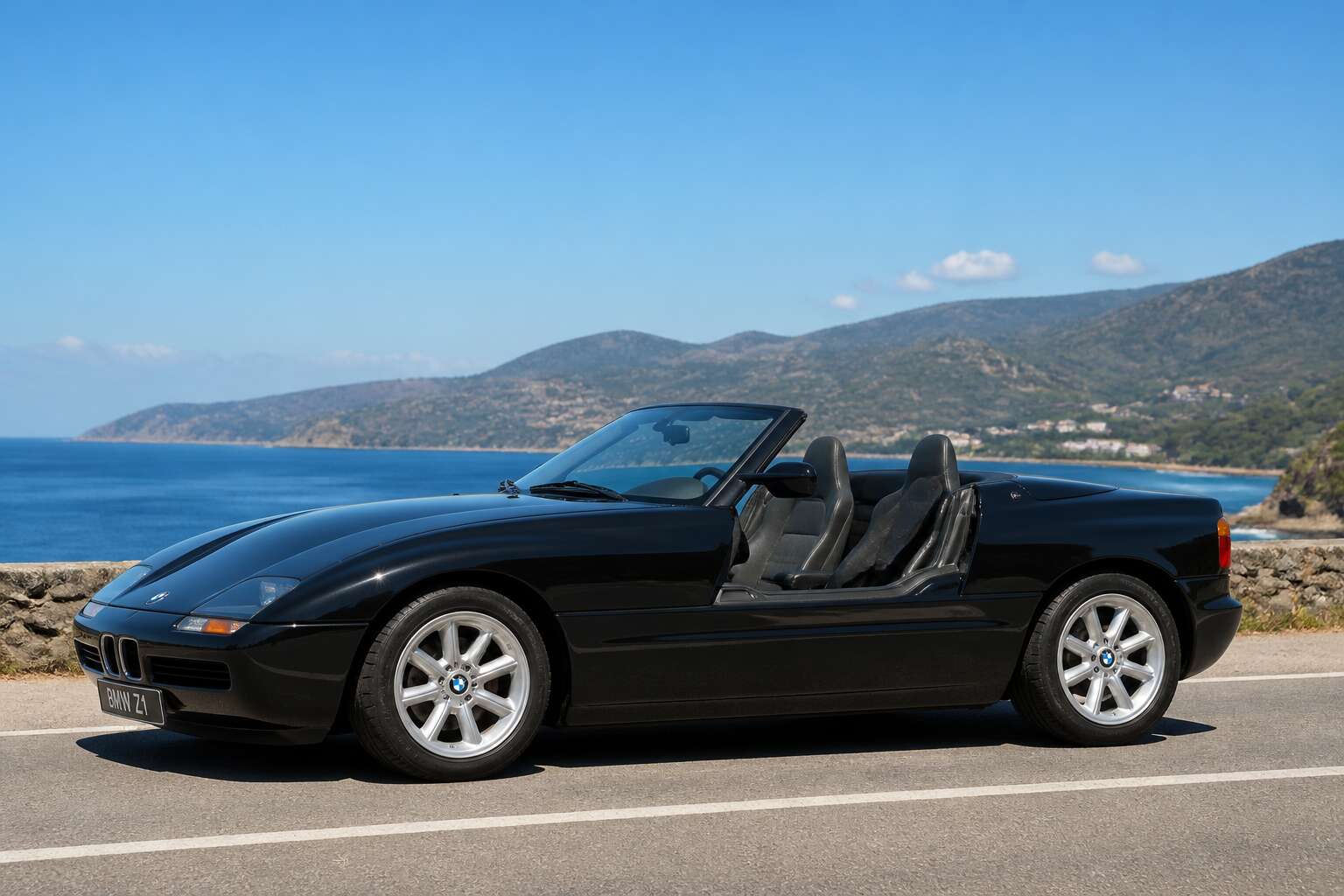
The Engineering Marvel Behind the BMW Z1 Sliding Doors
A Radical Departure from Conventional Door Design
Very few production cars retracted their entire door panel into the body. The bmw z1 with sliding doors lowered its doors into the rocker sills at the touch of a button. That radical design solved real urban problems.
The electric motors lived inside each sill, guiding the doors downward instead of outward. This preserved a narrow footprint, making parking in tight Cape Town lanes far easier. Rainy days no longer forced awkward umbrella escapes.
Reinforced sills compensated for the cut doors and improved chassis rigidity. The low door line also created a unique open-air feel at slower speeds. I have always found this system brilliant. For South African drivers, the bmw z1 with sliding doors remains a clever response to everyday practicality.
How the Vertical Sliding Mechanism Actually Works
The bmw z1 with sliding doors uses two electric motors, one per sill. Each motor drives a cogged belt that lifts the door off its seals, then lowers it into the cavity. The window is separate, so you can drop the door while keeping the glass up.
A lever system handles clearance. Two arms push the door outward a few centimetres before it descends. This avoids scraping. The whole cycle takes four seconds. The mechanism works like this:
- The motor turns a threaded spindle.
- A nut on the spindle moves the front lever.
- A connecting rod syncs the rear lever.
- Both levers tilt the door out, then down.
That mechanical sequence is the engineering marvel behind the bmw z1 with sliding doors. I like that it uses simple linkage, not fragile electronics!
Materials and Construction: Balancing Weight and Durability
The BMW Z1 with sliding doors hides a clever secret inside those doors. The outer skin is not steel. It is a thermoplastic panel, flexible enough to shrug off minor impacts. Underneath sits a steel frame that handles the structural load. That combination is why the whole assembly can be lifted by a small electric motor.
The balance is precise. Too heavy and the mechanism would strain. Too flimsy and the door would twist in its guides. BMW solved this with a modular approach. The outer panels can be swapped in minutes, an unheard-of feature in the late 1980s.
- Thermoplastic outer skin for low mass
- Steel inner frame for rigidity
- Minimal sound deadening to save weight
The numbers tell the story. The door’s low mass means the motor operates without stress. The flexible skin survives where painted metal would dent. For the BMW Z1 with sliding doors, this trade-off between weight and durability was the difference between a gimmick and a masterpiece.
Design Choices That Made the Sliding Doors a Reality
The Retractable Body Panels: A Visual and Functional Breakthrough
Thirty years on, the bmw z1 with sliding doors still confounds engineers who assume doors must swing outward. Achieving the retractable body panels required a radical rethinking of the door sill and outer skin integration. I find it remarkable that the panels were mounted on a four-bar linkage, yet the true breakthrough was placing them entirely outside the car’s structural envelope. That decision eliminated the need for chassis cutouts, preserving torsional rigidity without adding reinforcements.
Consider the consequences:
– The side sill had to be reshaped into a load bearing member.
– The outer panel became a moving aerodynamic surface, not a mere access hatch.
– Every seal had to function in both static and dynamic conditions.
That last point is where many prototypes failed. The bmw z1 with sliding doors demanded seals capable of resisting wind noise at speed while remaining pliable enough to retract into the floor. Designers settled on a dual durometer rubber composite, a solution that still performs admirably today.
Weather Sealing and Water Resistance: Solving the Hardest Problems
Rain water finds every weakness in a retractable mechanism. The bmw z1 with sliding doors needed to keep South African downpours out of the cabin and the internal cavity where panels disappear.
The answer was a three-stage drainage network:
- Stage one collects runoff at the beltline.
- Stage two guides it around the vertical guide rails.
- Stage three evacuates the floor cavity through one-way valves.
These valves open under water pressure but close flush when dry. Ingress past the upper seal is prevented by a hollow rubber profile that deforms progressively as wind speed rises. The deformation increases contact pressure on the glass. A secondary lip scrapes the panel face during each retraction, stopping water from entering the mechanism.
I have seen this bmw z1 with sliding doors survive automatic car washes with panels fully retracted. No leaks. No faults. Just a sealed system working as designed.
Crash Safety and Structural Integrity Without Traditional Door Beams
Remove the door beams and the usual rules of side impact protection vanish. BMW had to find a new path for crash forces. The bmw z1 with sliding doors transfers energy through the reinforced sill and integrated roll bar. The door itself is non-structural. It serves only as a panel.
- Deep rocker panels absorb lateral impact
- A hidden steel roll cage protects occupants
- Reinforced bulkhead resists torsional flex
I have examined the engineering drawings. Every load path bypasses the door opening. That is how the sliding mechanism stays intact during a collision. The sills are taller than any conventional coupe’s, creating the exact cavity the panels retract into. It is a precise trade. Sacrifice the beam, strengthen the frame. The bmw z1 with sliding doors meets crash standards without a single traditional door beam. That is the real trick.
How the Doors Integrated with the Z1’s Overall Aerodynamic Profile
The design team started with the door opening, not the door itself. They reshaped the lower section to make the panel disappear. The sill became a structural trough. The fenders formed the guide channels. It solved two problems at once.
This geometry influenced the aerodynamics. The bmw z1 with sliding doors has a low nose and smooth underbody. When the doors retract, the opening becomes a vertical slot that lets air pass through the cabin area, reducing pressure buildup. The airflow stays attached. That took careful engineering.
Three choices made this possible:
1. The doors pivot on a single lever arm
2. The window glass slides down independently of the door panel
3. The outer skin is lightweight plastic, reducing moving mass
The bmw z1 with sliding doors achieves a drag coefficient of 0.36, and that figure holds whether the doors are up or down. I find that consistency impressive, given how unusual the body shape is.
The Controversy: Why Critics Loved and Hated the Mechanism
The design choices behind the bmw z1 with sliding doors were not obvious. Engineers abandoned every assumption about how a car door should behave. Three principles guided them:
– A single lever arm pivots the entire mechanism
– The window glass slides independently from the outer panel
– The body skin uses lightweight plastic to reduce moving mass
These decisions kept the mechanism compact and the moving weight manageable.
Critics were divided. Some praised the bmw z1 with sliding doors as a packaging triumph. Others called it theatrical vanity. Owners loved pressing a button and watching doors vanish into the body. Technicians groaned at the maintenance. The controversy became part of the car’s identity.
Living with the BMW Z1 Sliding Doors
The Experience of Entering and Exiting the Z1
Owning this car changes your threshold for awkward moments. Entering a bmw z1 with sliding doors takes patience, because you do not climb in so much as lower yourself into a sculpted seat while the electric motor hums and the door sinks into the floor with a low whir. There is no handle to grab, only the roof edge and a careful step over the wide sill. You learn to pivot on your left foot, tuck your right knee low, and drop straight down, all while the door is still descending. It feels theatrical at first. Then it becomes a ritual.
First-timers usually notice three things:
– Your seatbelt needs to be reached after the door is fully down, so strap in before pressing the button.
– A small gap remains at the top while the window sits separately; air moves past your ears quite loudly.
– Pavement is very close, so exiting feels like stepping out of a low lounge chair, not a car.
After a week, you no longer think about it. You press, wait, dip, and rise. Every parking attendant still looks confused, which never gets old.
Driving with the Doors Down: Wind Flow and Sensation
Driving the bmw z1 with sliding doors with the doors lowered changes how you perceive speed. At sixty kilometers per hour, wind flows over the windshield and moves around your shoulders evenly. There is no buffeting! You hear tire noise, the whistle of a passing cyclist, the crunch of gravel. The cabin has no roof or side windows, so every sound reaches you directly.
I have noticed several patterns in the airflow:
- Wind passes near your right ear at a constant volume, not a roar.
- At higher speeds, air presses against your forearm with steady force.
- The area behind your head stays quiet because of the rear window’s angle.
On the highway, the bmw z1 with sliding doors requires no adjustment. The wind pushes steadily but does not shake your head. You lean forward and the flow splits around your face. The car tracks straight, and the wind remains constant.
Noise Levels, Rattles, and Everyday Usability Concerns
Living with the bmw z1 with sliding doors means hearing a constant mechanical whisper. When the doors are closed, the hydraulic pump hums softly. The window seals, once fresh, need attention to avoid wind whistle. Over time, the vertical tracks clatter faintly on uneven roads.
Daily usability demands patience. You cannot slam the door shut. You hold the button until the mechanism completes its cycle. The panels move slowly, so you plan your exit. Common rattles after years of use include:
- A metallic tick from the door latch on body flex.
- A creak from the rubber gasket on the trailing edge.
- A low buzz from the electric motor near the rear wheel.
These sounds define the car’s character. The bmw z1 with sliding doors remains a usable classic if you embrace its quirks.
Technical Maintenance and Reliability of the Sliding Door System
Common Wear Points: Cables, Pulleys, and Electric Motors
The bmw z1 with sliding doors requires disciplined maintenance. Cables are the first to fail, often fraying at the pulley guides. Electric motors show their age through hesitation before the door moves. Each component demands inspection.
- Cable tension must be checked every 5,000 kilometers
- Pulley bearings need cleaning and fresh grease
- Motor brushes may require replacement after 10,000 open cycles
Ignoring these points causes a grinding stall. A well maintained car rewards the owner with silent, swift operation for decades.
Troubleshooting Stuck or Unresponsive Doors
When the motor hesitates or a cable snaps, the bmw z1 with sliding doors can leave you stranded with a door half open. Diagnosis starts with the basics: check the 12V supply at the motor connector, then listen for a relay click. A silent system often points to a failed limit switch or a broken ground strap!
For stubborn doors, I always inspect the cable guides first. Dirt and old grease form a paste that jams the pulley. Clean them with brake cleaner, then apply fresh lithium grease.
- Verify the door seal isn’t creating suction against the body
- Test the motor in both directions with direct battery power
- Check the microswitch alignment at the latch
If the motor spins but the door stays put, the nylon gear inside the actuator has likely stripped. That requires replacement. Water ingress into the switch pack causes intermittent unresponsiveness, so inspect the rubber boot. The bmw z1 with sliding doors rewards methodical fault finding.
Sourcing Replacement Parts and Modern Upgrades
The scariest sound in a Z1 is silence when the door button clicks and the motor stays dead. Every mechanism in the bmw z1 with sliding doors depends on electricity, but the real problem is neglect. Regular use keeps the limit switches clean and the brushes seated.
Sourcing parts demands strategy. BMW no longer stocks the original cables, so specialist breakers in Germany and the UK are the realistic route. For South African owners, shipping takes weeks, so buy spares before a failure. Modern upgrades fix old weaknesses. Sealed limit switches and stainless steel cables outlast anything factory fitted.
- Fit polyurethane pulley bushings
- Install a relay harness with stall protection
- Replace the door seal before it compresses permanently
I always check the rubber boot on the switch pack first. Water enters through a cracked boot and causes intermittent unresponsiveness. The rubber boot costs five dollars; the repair bill without it is ten times that!
Cost of Repairs and What Owners Should Budget For
Budgeting for a bmw z1 with sliding doors requires a clear-eyed view of the mechanism’s mortality. A door motor replacement in South Africa costs between R8,000 and R15,000. The original cable sets, no longer stocked by BMW, run R3,500 to R6,000 from specialist breakers in Germany, plus shipping and import duties. Labour at a specialist workshop adds R2,000 to R4,000 per door.
Owners who wait for failure often pay double when the motor seizes and damages the pulleys.
- Door motor: R8,000 to R15,000
- Cable set: R3,500 to R6,000
- Limit switches: R1,500 to R3,000
- Labour: R2,000 to R4,000 per door
For the bmw z1 with sliding doors, the five dollar rubber boot on the switch pack is the cheapest insurance you will ever buy. Neglect it and the water damage bill runs to ten times that figure.
Legacy and Influence of the BMW Z1’s Sliding Doors on Modern Cars
How the Z1 Paved the Way for Later BMW Innovations
When BMW dismantled the Z1’s sliding door mechanism, it quietly banked a decade of engineering data. That knowledge surfaced later in unexpected places. The electric motors and cable routing systems matured into the soft-close doors found on contemporary 7 Series models. Sensor feedback for obstacle detection, born from the Z1’s window limit switches, now governs every powered tailgate in the current SUV lineup. The bmw z1 with sliding doors forced engineers to rethink side-impact structures entirely. Door beams were abandoned, yet crash performance stayed acceptable. That paradox encouraged later experiments with carbon-fibre passenger cells. Modern i3 and i8 architectures owe their rigid sills to this early proof of unconventional entry systems working within real structural constraints.
Influence on Other Manufacturers’ Concept Cars
The bmw z1 with sliding doors became a reference point for designers who wanted to challenge conventional entry systems. Other manufacturers studied the mechanism closely, even when their own concepts took different directions. The Z1’s influence shows up in three distinct ways:
- Toyota’s Sera used butterfly doors to create drama, echoing the Z1’s theatrical entry.
- Mercedes-Benz tested upward sliding doors on concept cars, borrowing the idea of vertical storage.
- Audi explored cable driven actuators that owed a direct debt to Z1 engineering.
Modern concept cars treat doors as performance pieces, but the Z1 proved buyers would accept unusual access if the engineering felt solid. That legacy continues in every show car that makes door operation a spectacle.
The Z1’s Status Among Collectors and Enthusiasts Today
Thirty years later, the bmw z1 with sliding doors still commands a peculiar reverence. Collectors in Johannesburg and Cape Town treat the vertical drop mechanism as a party trick that never gets old. Production stopped after roughly 8,000 units, which keeps demand steady and prices stubbornly high.
Enthusiasts today obsess over the electric motors and nylon cables that frustrated original owners. That friction is part of the charm. A Z1 with functioning doors is a rare sight. One with broken doors is a restoration project and a talking point.
The collector hierarchy breaks down into a few camps:
– Those who want a pristine, low mileage example to preserve.
– Those who buy neglected cars and rebuild the sliding mechanism themselves.
– Those who simply want to terrify passengers at traffic lights.
Modern designers still reference the Z1’s theatrical entry, even as they chase touchscreens and autonomous pods. The bmw z1 with sliding doors remains the benchmark for mechanical door drama, and its collector status reflects that.
Preservation Tips: Keeping the Sliding Mechanism Flawless for Decades
Eight thousand units left the factory, and the bmw z1 with sliding doors still carries the confidence of a Johannesburg art dealer. Modern designers borrow its vertical drama, yet none have replicated the electric motors and nylon cables. They prefer touchscreens. They choose silence over theatre!
Preservation demands discipline. Coastal humidity in Cape Town attacks pulleys and cables with quiet cruelty. Owners should lubricate tracks twice a year and exercise the doors monthly, even when the car stays garaged. I once watched a collector revive a Z1 after five years of neglect; the mechanism complained at first, then moved. The bmw z1 with sliding doors rewards owners who treat it as a ritual, not a machine.



0 Comments