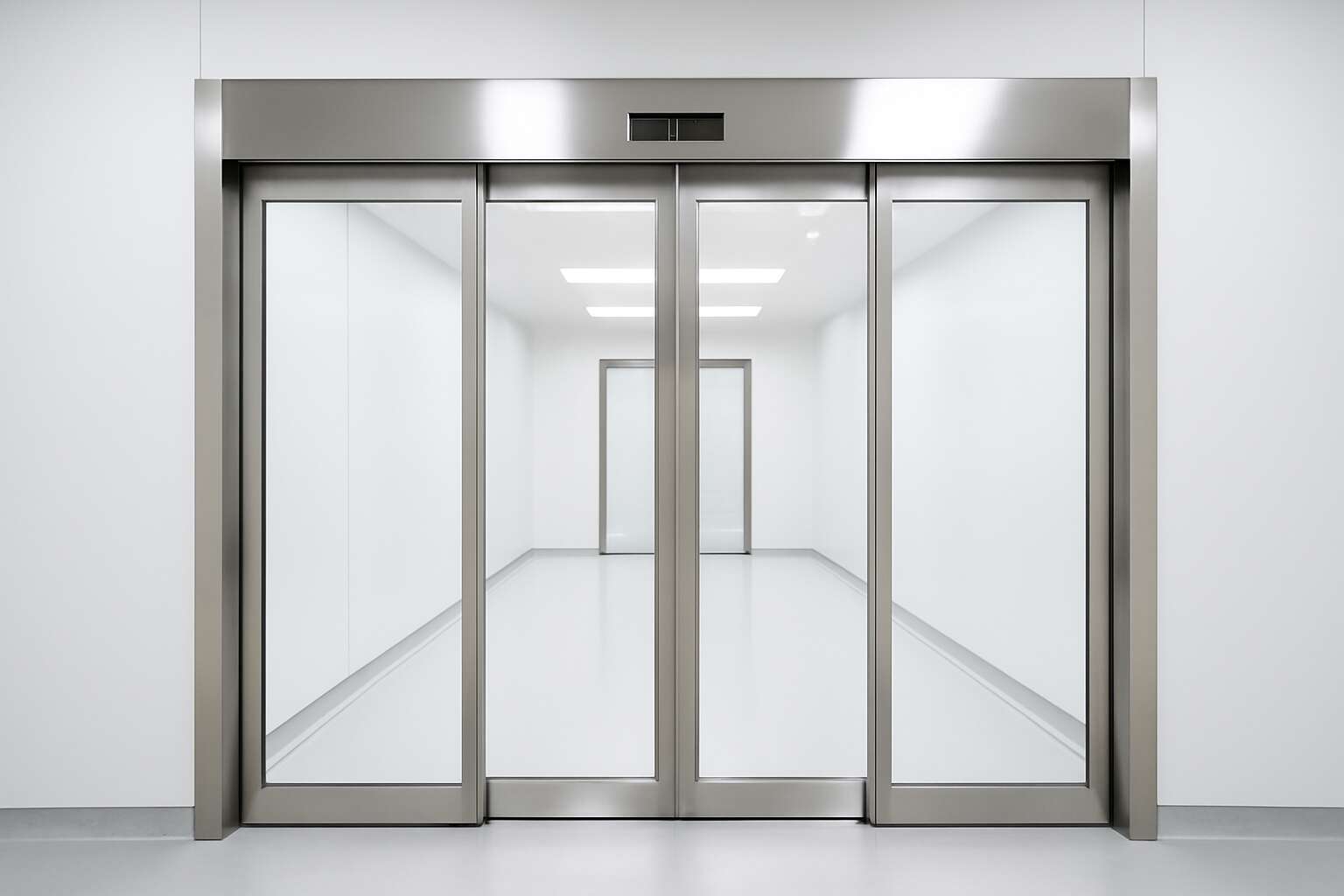
Cleanroom sliding door technology and design
Basics of cleanroom door types
Cleanliness is a production guarantee in modern labs and factories. A door is more than entry—it is a line of defense. “Every second counts,” a factory manager says. Clean room automatic sliding doors sit at that edge.
Technology blends speed, seals, and sensors. These doors use gasketed tracks and touchless operation to cut contamination while preserving airflow.
- Gasketed tracks and cleanable surfaces to minimize particle shedding
- Touchless sensors and auto-reverse safety features
- Integrated air seals for stable differential pressure
Cleanroom door types vary to fit workflow and space. Sliding doors save floor area, hinged doors suit tight corners, and pass-through designs speed transfers without opening the room. Each choice balances access with containment.
In South Africa’s pharmaceutical and medical sectors, durability and easy maintenance are non-negotiable. Coatings resist corrosion and IPC-compliant hardware keep facilities running.
Principles of air cleanliness and pressure containment
Sterile spaces run on a blade-edge of timing and containment. In this theatre, doors are more than entryways—they guard the airflow that keeps a product pristine. These are clean room automatic sliding doors—sitting at that edge, blending speed with surface chemistry to cut contamination while preserving pressure and draft lines.
- Gasketed tracks and cleanable surfaces to minimize particle shedding
- Touchless sensors and auto-reverse safety features
- Integrated air seals for stable differential pressure
Principles of air cleanliness lean on disciplined airflow, robust seals, and predictable differential pressure. The door itself becomes a component of the cleanroom’s barrier, guiding laminar flow rather than disturbing it. For South Africa’s pharmaceutical and medical facilities, coatings that resist corrosion and IPC-compliant hardware ensure long service lives.
Material choices and surface finishes
Every breath matters in a cleanroom—one stray particle can undo hours of sterile effort! During design reviews, I see the clean room automatic sliding doors guard laminar flow while easing daily workflow. Material choices lean toward non-porous, cleanable surfaces that resist cleaning solvents and corrosion, a necessity in South Africa’s humid production spaces.
Smart design combines robust seals with surfaces that shed particles rather than hide them. During design reviews, these doors guard laminar flow while easing daily workflow.
- Stainless steel frames with PVDF or epoxy coatings for corrosion resistance
- Anodized aluminum with antimicrobial finishes
- Glass with chemically resistant edge treatments for visibility and cleanability
Surface finishes balance aesthetics, durability, and sanitation, while IPC-compliant hardware ensures reliability in critical environments.
Compliance, standards, and certifications
ISO class requirements and cleanroom interfaces
In South Africa’s laboratories and biomanufacturing floors, a single breach can derail a batch and cost more than fines. ISO-class compliance isn’t optional—it’s a lifeline for facilities that demand reliability. Doors chosen for these environments quietly uphold steady air boundaries and predictable workflows.
ISO 14644 guides classifications from ISO 5 to ISO 9, and certifications verify door performance, leak resistance, and cleanroom interfaces. Clean room automatic sliding doors are designed to meet these expectations while integrating with anterooms, air curtains, and interlocks.
To align with ISO class requirements, focus on how the door interfaces with gowning rooms, airlocks, and clean corridors.
- Seamless airflow at the jamb
- Interlock performance with pass-throughs
- Auditable documentation of class conformity
Certification for HACCP, GMP, ISO 14644
Compliance is not a ritual; it’s the warranty on a batch’s fate. In South Africa’s labs and biomanufacturing floors, a single deviation can derail an entire run, inflating costs and erasing hours of careful work. Clean room automatic sliding doors stand as the quiet guardians of that promise.
Certification for HACCP, GMP, and ISO 14644 anchors choice and operation, tracing every performance moment—from leak resistance to clean interfaces. The aim is auditable conformity with doors that prove their worth under pressure and when quiet pass-throughs are demanded.
- HACCP
- GMP
- ISO 14644
These standards ensure that these doors integrate with gowning rooms, airlocks, and clean corridors, maintaining seamless airflow at the jamb and reliable interlock passes, all while leaving a clear audit trail.
Validation approaches: IQ/OQ/PQ
On South Africa’s cleanroom floors, compliance isn’t a ritual—it’s a lifeline. A single deviation can derail a run and erase hours of careful work, yet the right hardware can turn risk into reliability. The clean room automatic sliding doors stand as quiet sentinels of that promise, their integrity proven under pressure and through routine pass-throughs.
Validation approaches—IQ, OQ, and PQ—anchor every phase from installation to ongoing performance. The auditable trail shows leaks held at bay, clean interfaces intact, and interlocks that function when the line hums.
- Installation Qualification (IQ): confirms correct setup and integration with gowning rooms and airlocks.
- Operational Qualification (OQ): tests door timing, interlocks, and safety sensors under expected conditions.
- Performance Qualification (PQ): validates consistent performance during routine manufacturing cycles.
Together, these steps ensure that clean room automatic sliding doors contribute to a seamless, compliant workflow on SA biomanufacturing floors.
Documentation and traceability
Audits in South Africa’s biomanufacturing spaces reveal a blunt truth: 87% of findings trace to paperwork, not pipes or pacts. In this arena, clean room automatic sliding doors are not mere hardware; they are living parts of a documented quality system, quietly confirming that every pass-through is tracked, every interface traced. Compliance isn’t ceremonial; it’s a continuous dialogue between performance and record-keeping, ensuring regulators can follow the chain from receipt to operation and back again, in step with ISO 14644 and SA expectations.
Documentation and traceability for these doors cover the lifecycle:
- Component supplier declarations and material certificates
- Site commissioning records and as-built documentation
- Maintenance, calibration, and preventive-maintenance logs
- Change control and deviation reports
- Event audit trails linked to production runs
Together, they bolster the reliability and integrity of clean room automatic sliding doors, turning compliance into quiet, everyday confidence.
Performance, reliability, and maintenance
Door reliability in high-traffic cleanrooms
A recent industry snapshot shows that clean room automatic sliding doors, when properly specified, can cut particle ingress by up to 40% in busy zones, preserving laminar flow and product integrity. Performance in high-traffic cleanrooms hinges on more than speed; it hinges on trust.
From my experience, durability and reliability come from robust design, quiet operation, and intelligent monitoring that keeps downtime to a minimum. Beyond speed, maintenance-friendly components and corrosion-resistant surfaces extend the life of the door and its seals.
- Durable seals and low-friction tracks maintain containment during peak shifts
- Robust motors and soft-close action reduce mechanical wear
- Integrated diagnostics support predictive maintenance without disrupting workflow
Maintenance becomes a philosophy of vigilance, especially for South Africa’s demanding cleanroom environments, where local service networks and rapid response matter as much as the door itself. That is why clean room automatic sliding doors demand meticulous engineering and ongoing support. The door’s reliability is a reflection of the room’s integrity—and a quiet, persistent guardian of quality.
Motorization and sensing technologies
Performance in high-traffic zones is a quiet negotiation between speed and trust. The phrase clean room automatic sliding doors sits at the heart of South Africa’s busy cleanrooms—swift enough to keep lines moving, steadfast enough to preserve product integrity.
Motorization and sensing technologies justify their existence beyond slogans. Robust motors pair with soft-close action and low-friction tracks to minimize wear and maintain containment. Sensing intelligence—laser beams, edge sensors, and occupancy-aware logic—prevents unnecessary openings and preserves laminar flow, even during bustling shifts.
- Integrated diagnostics support predictive maintenance without disrupting workflow
- Remote monitoring enables rapid response across South Africa’s service network
- Wear indicators highlight seals and tracks before fatigue
Maintenance becomes a philosophy of vigilance; the door is a quiet guardian, never grandstanding but always present.
Cleaning, sterilization, and corrosion resistance
In South Africa’s busiest cleanrooms, doors work quietly like sentinels. Clean room automatic sliding doors can slash containment breaches during peak shifts by up to 40%, a statistic that underlines their balance of speed and trust. They aren’t showpieces; they’re guardians keeping lines moving while preserving product integrity.
Performance hinges on surfaces and design that shrug off routine sterilization and harsh cleaners. 316L stainless steel hardware, low-porosity glass, and passivated frames resist corrosion, while slick tracks and soft-close action minimize wear and maintain a reliable seal after countless cycles.
- 316L stainless steel seals and corrosion-resistant gaskets
- Wash-down friendly tracks with rounded edges
- Sterilization-compatible lubrication and low-friction bearings
Maintenance becomes a discipline; integrated diagnostics and remote monitoring keep South Africa’s service network aligned. The door remains a quiet guardian—always present, never loud, ready to defend purity with every cycle.
Energy efficiency and airlock integration
Whispers ride the airflow as clean room automatic sliding doors move with patient precision. In peak shifts, they slash containment breaches by up to 40%—a statistic that underlines their balance of speed and trust. They’re guardians, not showpieces, guiding the line while preserving product integrity. I’ve watched them stand watch in South Africa’s busiest cleanrooms, quiet as midnight, unwavering as cathedrals.
Reliability rests on choreography and a maintenance discipline that never sleeps. Integrated diagnostics and remote monitoring keep the service network aligned, so every cycle returns with a sealed sigh rather than a creak. Energy efficiency threads through the design: efficient drives, smooth tracks, and sensing that avoids needless openings. For airlocks, synchronized door pairs hold pressure, and the vestibule breathes in step with the process.
- Energy-efficient drives and low-friction bearings
- Airlock integration with synchronized door pairs
- Remote diagnostics and proactive maintenance alerts
Maintenance becomes a habit; alerts arrive before trouble does, and the door remains a quiet sentinel, economical with motion and generous with reliability. In this theatre, clean room automatic sliding doors are not merely access points; they are guardians of purity, efficiency, and calm in the controlled chaos.
Installation, integration, and lifecycle management
Site assessment and installation planning
Across South Africa’s biotech and pharmaceutical corridors, the impact of automation is tangible: clean room automatic sliding doors paired with smart controls cut contamination events by up to 40%. The right installation merges airflow science with dependable hardware, turning a door into a trusted barrier rather than a risk point.
Site assessment and installation planning demand a meticulous audit of room interfaces, pressure differentials, utility readiness, and control compatibility.
- Site survey and airflow mapping
- Mechanical integration with cleanroom seals and tracks
- Electrical, data, and control interface readiness
This groundwork ensures seamless installation and clean integration with existing environmental controls, reducing retrofit risk.
Lifecycle management for this door system means planning for wear, corrosion resistance checks, and routine recalibration of sensors and actuators. With a forward-looking maintenance plan, downtime is minimized and performance stays airtight across shifts and seasons in South Africa’s facilities.
Integration with HVAC and air curtain systems
In South Africa’s biotech and pharma hubs, the installation of clean room automatic sliding doors can lower contamination risk by up to 40% when they operate in harmony with smart controls.
Integration with HVAC and air curtain systems keeps pressure differentials stable as doors cycle, a quiet pact between airflow and metal, preserving laminar flow and minimizing turbulence.
- HVAC compatibility checks
- Air curtain alignment and seal integrity
- Control interface readiness and redundancy
Lifecycle management demands a proactive plan: wear and corrosion checks, periodic sensor recalibration, and scheduled spare-parts reviews to stay airtight through shifts and seasons.
Training, SOPs, and documentation
Installation starts with site readiness, precise mounting, and factory checks. Integration follows—the door controls aligning with the cleanroom’s rhythms to ensure reliable cycling without disturbing laminar flow. Clean room automatic sliding doors are not mere frames; they are containment components that demand precise planning and airtight documentation from day one.
Training, SOPs, and documentation anchor ongoing success. A concise program covers safe operation, door cycling, emergency overrides, routine cleaning, and fault logging. The accompanying SOPs spell out calibration schedules, sensor checks, and spare-parts handling. For reference, clean room automatic sliding doors demand clear record-keeping from installation onward.
- Operator training on cycling sequences and safety
- Maintenance workflows and fault logging
- Calibration, sensor checks, and spare-parts control
With a proactive lifecycle approach, wear and corrosion checks, recalibration, and spare-parts reviews become routine. Digital records with version control enable quick audits and seamless shifts in fast-moving environments.
Supplier selection and ROI considerations
Total cost of ownership and lifecycle costs
Supplier selection for clean room automatic sliding doors is more than a quote; it is a pact with uptime, sterility, and future-proofing. I weigh track records, service density, and response times as keenly as price. In South Africa, a partner with local technicians and spares can shave days from downtime, turning a potential liability into a measurable ROI.
Total cost of ownership and lifecycle costs matter more than the initial price tag. Look for modular designs, remote diagnostics, and warranties that cover critical components. A transparent supplier will outline all costs—installation, calibration, energy use, and future upgrades—so you can plot a steadier, safer course for your clean room automatic sliding doors.
- Local support networks and timely spare parts availability
- Transparent warranties, maintenance intervals, and service commitments
- Lifecycle cost insights, including energy use and future upgrades
Vendor qualification and audits
In SA plants, a single hour of downtime can cost more than a day’s revenue. Behind every clean room is a partner you can rely on. Uptime is more than a metric—it’s ROI, turning outages into throughput. Supplier selection for clean room automatic sliding doors is a pact: weigh track records, response times, and spares as keenly as price.
- On-site references and performance history
- Transparent maintenance schedules and response commitments
- Local technicians and spare parts availability
ROI becomes a tangible figure when a supplier clearly spells out all costs—installation, calibration, energy use, upgrades—so you can forecast with confidence. A vigilant partner provides vendor qualification and audits as part of the package, not a handshake at the gate. With the right alignment, clean room automatic sliding doors give you steady air, steady output, and a touch of almost-supernatural reliability.
Case studies and industry applications
In South Africa’s high-stakes labs, one hour of downtime can swallow a day’s revenue faster than a QA checklist. When the door to your clean room holds up production, you need a partner who understands uptime—and clean room automatic sliding doors that actually deliver it.
Supplier selection is a pact, not a gamble. On-site references and performance history, transparent maintenance schedules and response commitments, and local technicians with ready spare parts matter more than glossy brochures.
- On-site references and performance history
- Transparent maintenance schedules and response commitments
- Local technicians and spare parts availability
ROI becomes tangible when costs are laid bare—installation, calibration, energy use, upgrades—so forecasts feel less like guesses. Case studies across pharmaceutical, biotech, electronics, and food industries in SA show clean room automatic sliding doors cutting outages and preserving throughput.
Sustainability and energy impact
One hour of downtime can erase a day’s revenue in South Africa’s labs, so supplier selection is a pact, not a punt. Seek partners who prove uptime in similar deployments, publish clear maintenance covenants, and offer a local technician network with ready spares—clean room automatic sliding doors that perform, not promise.
Consider these readouts as you evaluate partners:
- Audited performance histories from similar facilities
- Clear SLAs and local spare parts support
ROI becomes tangible when costs are laid bare—installation, calibration, energy use, upgrades—so forecasts stop leaning on guesswork. Case studies in SA show clean room automatic sliding doors reducing outages and preserving throughput across pharma, biotech, electronics, and food sectors.
Sustainability and energy impact matter as much as speed and seal integrity. Efficient motors and smart scheduling cut energy footprints while preserving sterile performance. Those doors earn their keep when meters tick down, delivering a greener workflow with poise.



0 Comments